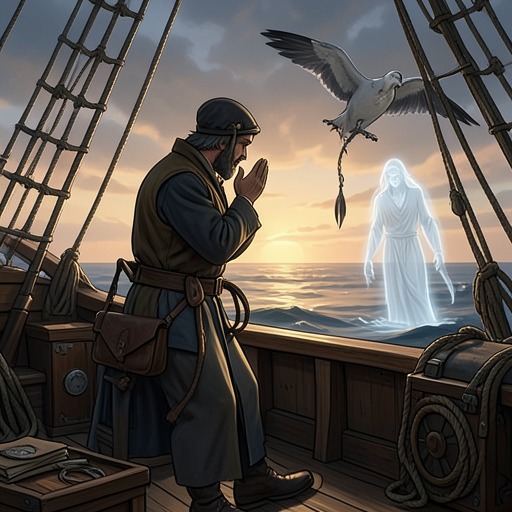
The Mariner’s compulsion to tell his tale
The Rime of the Ancient MarinerThe Ancient Mariner’s compulsion to tell his tale is the recurring force that makes his private suffering into an encounter with a listener. Speaking does not simply express what he has endured: a sudden agony compels him to begin, releases him when the account is finished, and returns at uncertain intervals until he finds someone who must hear it. The tale is therefore both a burden he cannot set aside and the means by which each episode of that burden ends.
The Compulsion and Its Release
The compulsion arrives as physical anguish. When the Ancient Mariner is asked what kind of man he is, his frame is wrenched by a woeful agony, and the pain forces him to begin his tale. The account is not presented as a speech freely chosen for the occasion: bodily suffering initiates it. Once the telling has begun and the tale is delivered, the agony leaves him free. The sequence makes narration itself an enforced response to pain, with temporary relief as its immediate consequence.
That release is not permanent. The Ancient Mariner says that the agony returns at an uncertain hour, without giving a schedule or warning by which it might be anticipated. Until the ghastly tale is told, his heart burns. The recurring condition binds together an invisible inward distress and an outward act of narration: the listener receives the story because the speaker cannot escape the need to tell it. Relief depends not merely on having suffered, but on recounting the suffering to another person.
A Journey Between Listeners
The Ancient Mariner describes himself as passing like night from land to land and possessing a strange power of speech. His movement gives the compulsion a recurring, itinerant form. He does not describe a single occasion on which the tale is told and finished forever; the returning agony sends him onward, so that one telling's release exists alongside the prospect of another telling elsewhere.
The next listener is not simply whoever happens to be present. The Ancient Mariner says that the moment he sees a man's face, he knows that man must hear him, and he teaches his tale to that person. The encounter thus has two distinct stages: recognition selects the hearer, and the compulsion brings the narrative forth. The Ancient Mariner presents this ability as strange, but the passage does not explain its mechanism beyond his certainty that he can identify the person meant to listen.
Telling as Burden and Transmission
The language of teaching gives the repeated account a shape beyond involuntary speech. The Ancient Mariner does not only discharge pain; he passes the tale to someone else. His listeners become the human link through which an experience that isolates him is made audible. Yet transmission offers no final cure: each telling frees him for a time, while the uncertain return of agony preserves the need to continue.
The episode also makes the story's frame part of the subject. The Ancient Mariner recounts not only the events of his tale but the recurring circumstances under which he is made to recount it: the bodily seizure, the forced beginning, the temporary freedom, and the search for a face he knows. His account therefore presents narration as an event that happens repeatedly in the world of the poem, rather than as a transparent retelling with no cost to its speaker.
Significance of the Repetition
The pattern turns storytelling into both symptom and obligation. The burning heart marks what remains unresolved until speech occurs; the relief that follows shows the tale has been told, but the return of agony prevents that relief from becoming a permanent ending. The Ancient Mariner's movement from land to land extends the cycle beyond any one audience, while his recognition of the required listener makes each telling feel directed rather than indiscriminate.
This repeated structure also gives the encounter with a listener its own consequence. The Ancient Mariner cannot control when the agony returns, but he describes knowing whom it requires him to address. His compelled speech consequently joins distress to witness: another person must receive the story for the speaker to be released, even if only until the next uncertain hour. The compulsion is not merely a habit of retelling; it is the poem's account of how the Ancient Mariner's suffering continues to shape his life and his meetings with others.